
You Can Eat Less and Still Enjoy Food. The Sustainable Way Men Actually Keep Results – Episode 210


Episode Overview
Dietitian Dude David Orozco examines the science of sustainable calorie reduction for men — how eating a little less can produce real health results when done right, and what goes wrong when men take it too far. Drawing on the CALERIE Trial, the Minnesota Starvation Experiment, and RED-S research, the episode makes the case that moderate, enjoyable calorie reduction (12-15%) beats extreme restriction every time. David shares his own journey from restrictive clean eating to finding Gentle Nutrition, and introduces the 7 food groups framework and the enjoyment test as practical tools for building a deficit that actually lasts.
The Science of Moderate Calorie Reduction
The CALERIE Trial (NIH-funded, Duke/Tufts/Pennington) showed that participants who achieved approximately 12-15% calorie restriction — far less than the 25% target — improved insulin sensitivity, lipid profiles, and metabolic syndrome scores over two years. A 2024 study by Woźniak and colleagues compared 10%, 20%, and 25% deficits over six months, finding diminishing returns beyond 20%. Metabolic adaptation is real but modest (50-100 kcal/day), making moderate deficits sustainable without the metabolic shutdown that extreme cuts can trigger.
Where Extreme Deficits Go Wrong
The Minnesota Starvation Experiment (Keys, 1944) demonstrated the psychological consequences of severe restriction in healthy men: food obsession, depression, social withdrawal, rigid thinking, and effects that persisted into refeeding. Research on severe calorie restriction shows significant lean muscle mass loss (up to 50% of weight lost), reducing resting metabolic rate and creating a cycle of diminishing returns. RED-S research (IOC, 2018) shows men with low energy availability have lower testosterone, reduced bone density, and worse athletic performance, with men tolerating under-fueling longer before symptoms appear. The episode notes that for some men, what starts as healthy eating can cross into disordered eating territory — presenting differently in men (rigidity, exercise compulsion, social isolation) than what most people expect.
The Sustainable Approach
The episode introduces three pillars: enough food (a 15% deficit for a man eating 2,400 calories is about 2,040 — three meals and a snack), enough variety (eating from all 7 food groups — fruit, vegetables, grains, protein, dairy, fat, and fun — instead of the typical 2-3 food groups in extreme deficits), and enough enjoyment (the enjoyment test: “Am I satisfied?” and “Could I keep eating this way for a year?”). Research on carbohydrate restriction shows higher rates of binge eating and food cravings among restrictive dieters, supporting the case for variety over monotony.
Gentle Nutrition and the Curiosity Cycle
Intuitive Eating Principle 10 — Honor Your Health with Gentle Nutrition — provides the framework: nutrition that respects both health goals and enjoyment, positioned last among the ten principles because leading with nutrition rules before healing one’s relationship with food creates another cage. David shares how Gentle Nutrition gave him permission to eat carbs, enjoy dessert, and eat with friends again. The Curiosity Cycle (curiosity → open mind → exploration → experimentation → learning & growth → more curiosity) reframes the central question from “how little can I eat?” to “what does my body need to perform, feel good, and enjoy life?” The episode teases the next episode on sugar — added sugar, hidden forms, non-nutritive sweeteners — timed for Halloween through the holiday season.
The Alimentar Men’s Community
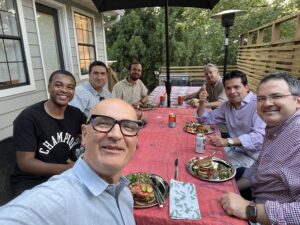
In the Alimentar Community we have offer weekly goals and challenges to encourage and motivate guys through their health journey. We have both online and in-person, and support each other through successes and challenges. We host monthly in-person get-togethers including cooking classes, walks, hikes, and fitness challenges. And we’re building an IRL community to combat the digital and ever growing disconnected age. Come join us today!
Tailgate Cookout
Resources
- If you like this episode, then download the show wherever you listen to your podcasts at Apple, Spotify, Stitcher, Google, iHeartRadio, Castbox
- Hit that subscribe button so you won’t miss another episode.
- Big Ask: Leave a Review! Please, take a few minutes and leave me a review on your podcast app. Each review helps other listeners find the podcast, which provides me with the ability to continue bring you unique content. So spread the love. Loss for words? Just write what you like about the show.
- Share the show with friends.
- If you want to work with us, schedule an appointment or a free 15 minute discovery call. Explore our website and click Schedule an Appointment. Or, reach us by email info@orozconutrition.com or phone 678-568-4717.
References
- CALERIE Phase 2 Trial — Effects of caloric restriction on physiological, psychological, and behavioral outcomes. — https://pmc.ncbi.nlm.nih.gov/articles/PMC7727025/
- CALERIE — Two years of calorie restriction and cardiometabolic risk factors. https://pmc.ncbi.nlm.nih.gov/articles/PMC6707879/
- Yang et al. (2022). Calorie restriction causes multiple beneficial metabolic adaptations linearly related with the degree of weight loss (CALERIE). — https://journals.sagepub.com/doi/10.3233/NHA-220180
- Woźniak et al. (2024). The impact of the size of the energy deficit on body weight over 6 months and willingness to continue. Food Science & Nutrition. — https://pmc.ncbi.nlm.nih.gov/articles/PMC11606885/
- Minnesota Starvation Experiment — Keys, A. et al. (1950). The Biology of Human Starvation. University of Minnesota Press. Summary: https://psychiatry.duke.edu/blog/starvation-experiment
- Effects of Starvation (Minnesota Experiment summary). Inside Out Institute. — https://insideoutinstitute.org.au/resource-library/the-effects-of-starvation
- IOC Consensus Statement on Relative Energy Deficiency in Sport (RED-S), 2018 Update. — https://www.researchgate.net/publication/325212903
- Metabolic adaptation and low-energy diets. — https://www.ncbi.nlm.nih.gov/pmc/articles/PMC8196522/
- Predictors of muscularity-oriented disordered eating behaviors in U.S. young adults. — https://pmc.ncbi.nlm.nih.gov/articles/PMC6901753/

Previous Episodes
Share your comments, relay topic ideas or ask David anything! Send David a note!
Looking for a guest on your podcast? Ask David about topics he can bring to your audience. Contact David today!